
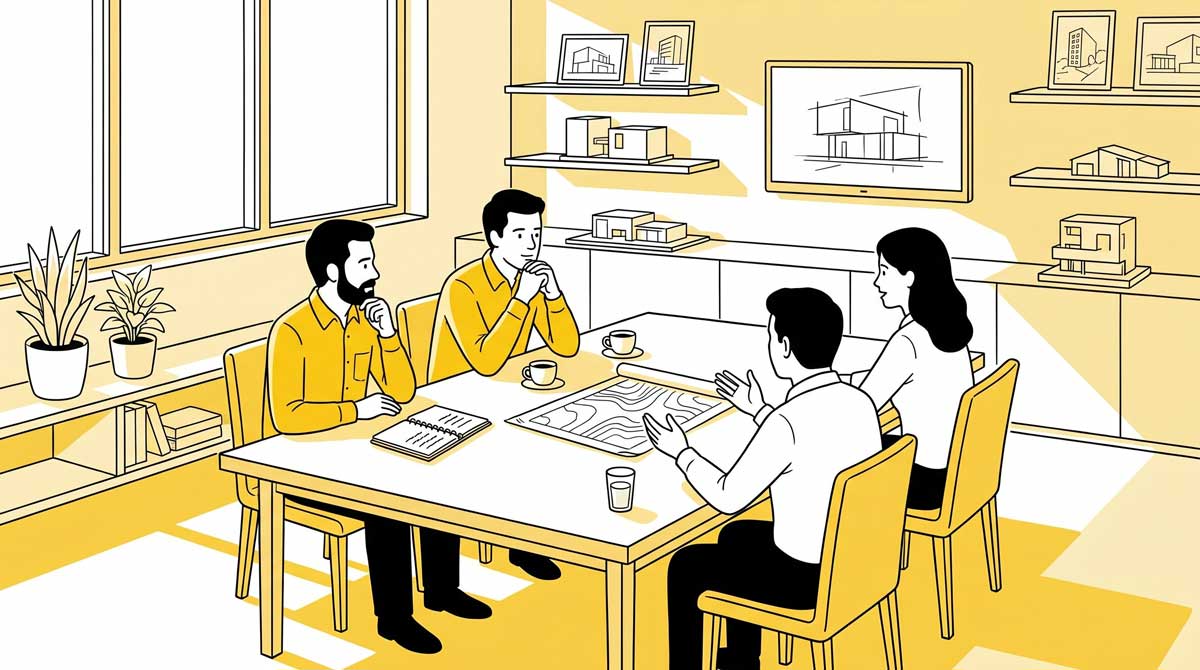
Every project is born from a conversation. Before talking about plans or materials, we want to understand what you need, what your priorities are, and what real limitations you have on the table. From there, we build a technical and spatial response that fits your specific situation.
At vi17 arquitectura, we work with individuals, developers, and administrations on new housing, renovation and rehabilitation, sustainable construction, and public space projects, with offices in Carballo (A Coruña) and Pamplona (Navarra).
Working with us does not require having everything clear from the beginning. Often, the best solutions appear precisely during that first conversation.
We do not have a catalog aesthetic. We have a method.
WHAT PROJECTS DO WE WORK ON?
These are the types of commissions we handle most frequently. If your project does not fit exactly into any of these categories, tell us anyway: working on the margins is where the most interesting solutions arise.
New housing: single-family and collective
Housing is where architecture has the most direct impact on people’s lives. That is also why we pay the closest attention to detail there.
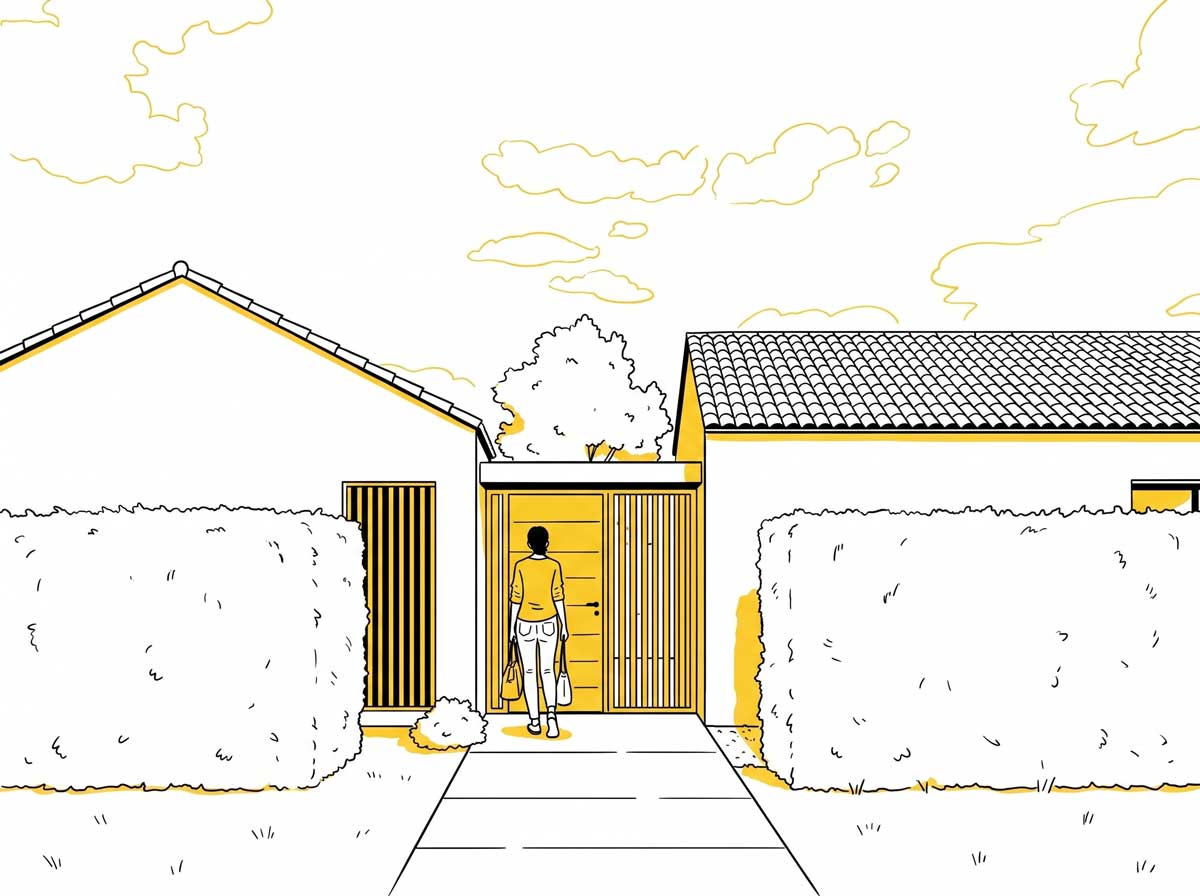
We design single-family homes in Galicia and Navarra adapted to the conditions of the site —climate, orientation, topography, municipal regulations— and to the real needs of whoever is going to live in them. No two programs are the same: we work on the space from scratch until it fits.
We also address collective housing and new models of living: multi-family buildings, cohousing, and typologies that respond to contemporary lifestyles. In all cases, the goal is the same: to optimize every square meter without sacrificing spatial quality or comfort.
Renovation and rehabilitation of housing
Intervening in what already exists is often the most complex commission —and the most rewarding. A comprehensive renovation or a well-executed rehabilitation can completely transform a space without the need to start from scratch.
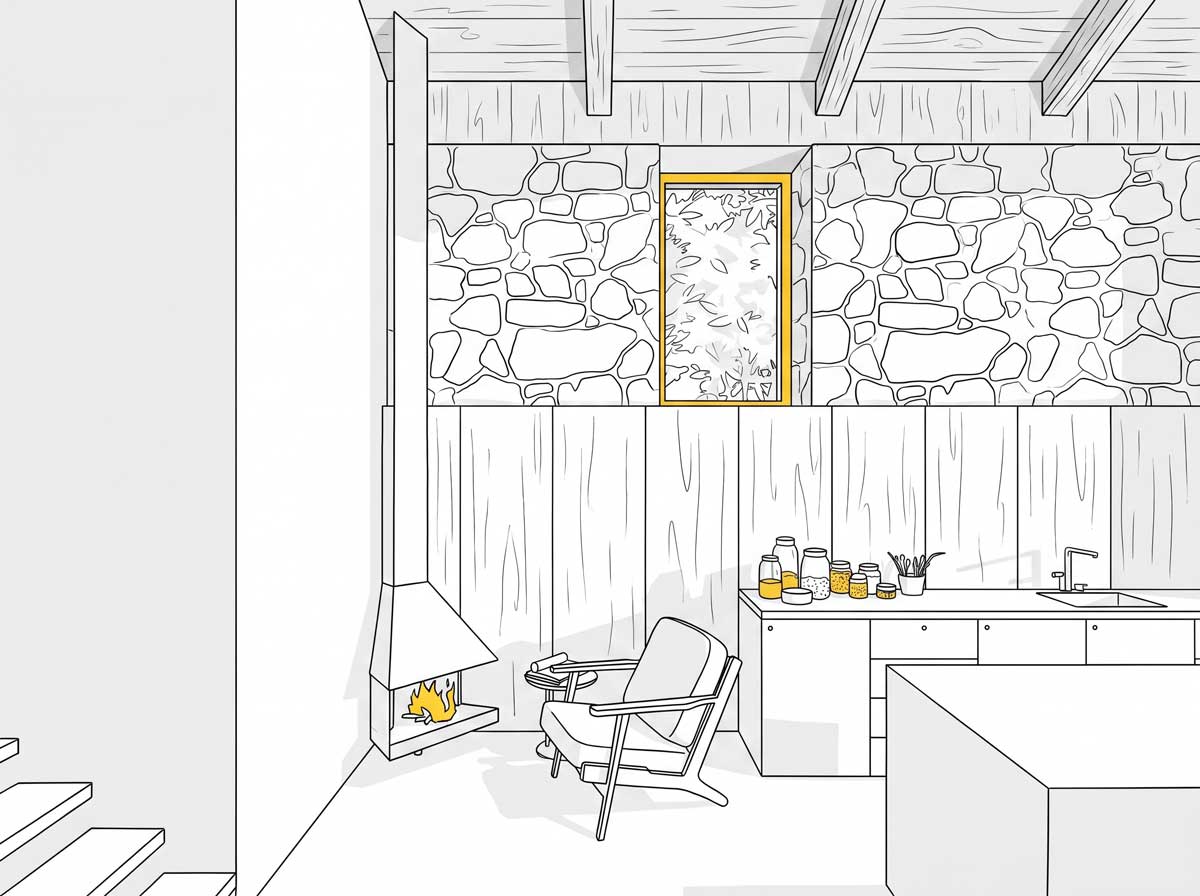
We work on both the rehabilitation of stone houses characteristic of the Galician rural environment and the renovation of apartments and buildings in urban environments. In both cases, our methodology starts from the same principle: understanding what holds value in the existing structure before deciding what to change.
We integrate energy efficiency solutions —insulation, controlled ventilation, high-performance woodwork— into pre-existing structures, improving comfort and reducing consumption without altering the identity of the building.
Sustainable construction and energy efficiency
Sustainability is not a label: it is a way of making technical decisions from the very beginning of the project. We work with a low-energy consumption approach that affects the orientation of the building, insulation, ventilation, and the choice of materials, with the goal of reducing energy expenditure throughout the entire life cycle of the building.
Within this approach, we consider different strategies and construction systems according to the characteristics of each project, including the use of natural materials like wood when it is the most technically and environmentally suitable solution. The result is buildings that guarantee a healthy indoor environment. A well-built house spends less and provides a better living experience.
Urban planning and public space
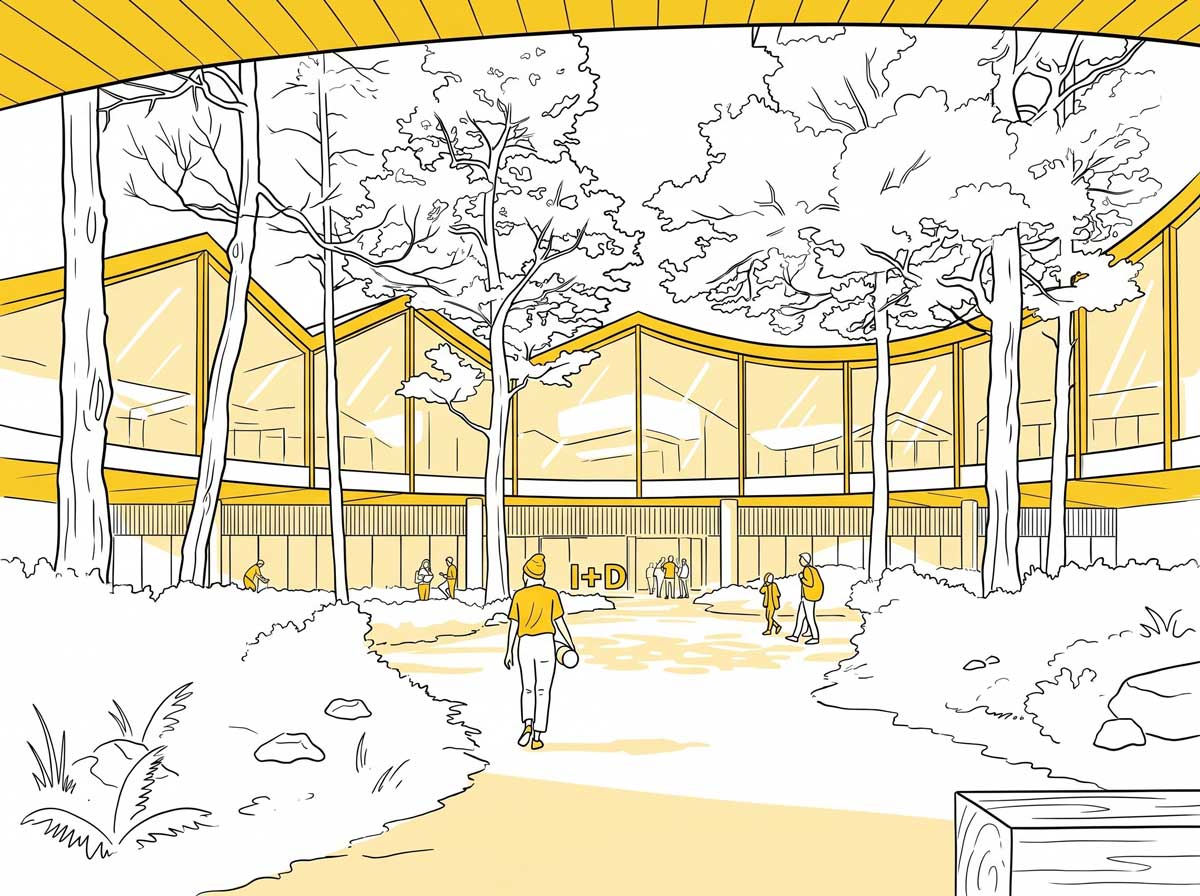
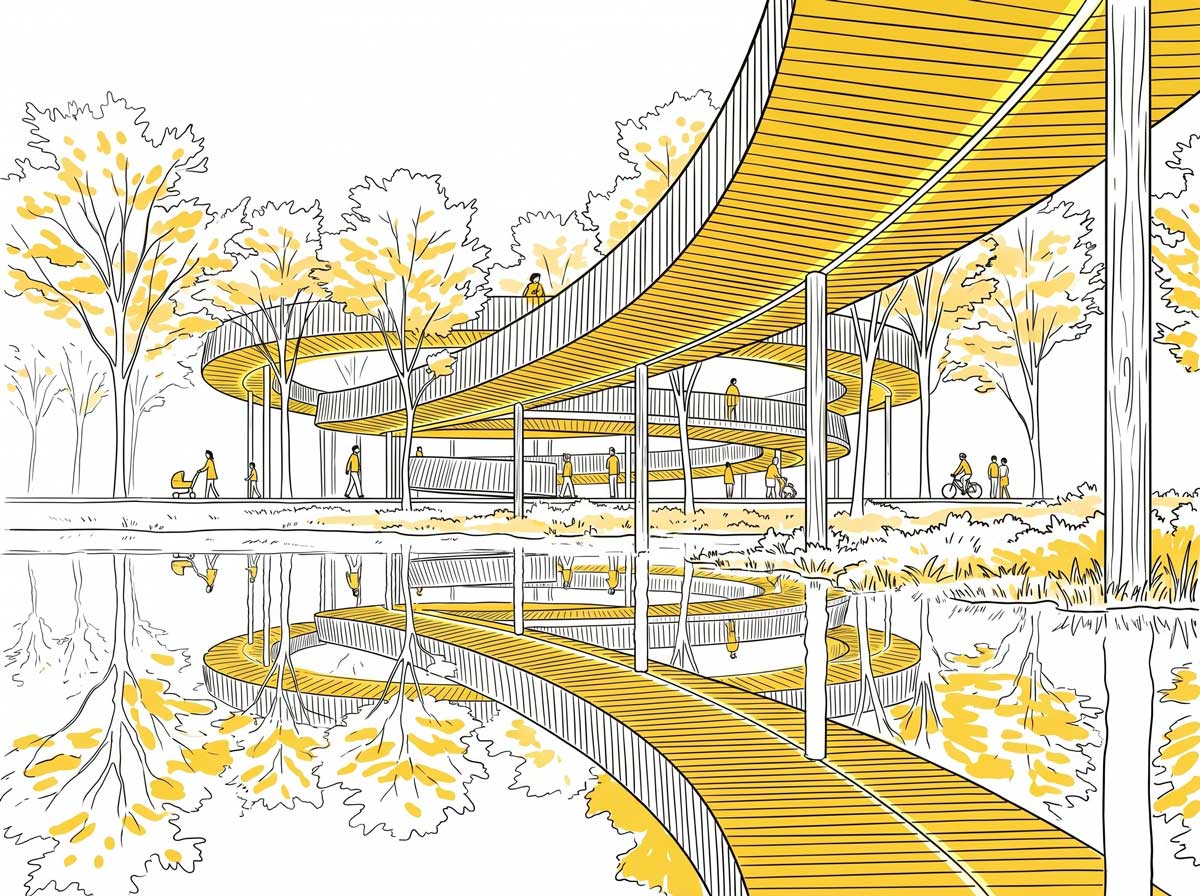
Public space is where the common ground is built. We work with town councils and public bodies on projects for urban regeneration, design of squares and community spaces, accessibility, and landscaping.
Our experience in architecture and urban planning competitions has allowed us to develop a methodology for territorial analysis that goes beyond superficial design: we study flows, scale, the memory of the place, and the real needs of users before proposing any formal solution.
We understand public space as a social infrastructure: a well-designed place changes the habits of those who use it, activates the commercial fabric of the surroundings, and reinforces the identity of the neighbourhood or city. That is why each proposal starts with a rigorous analysis of the context.
WHAT IS THE PROCESS OF WORKING WITH US LIKE?
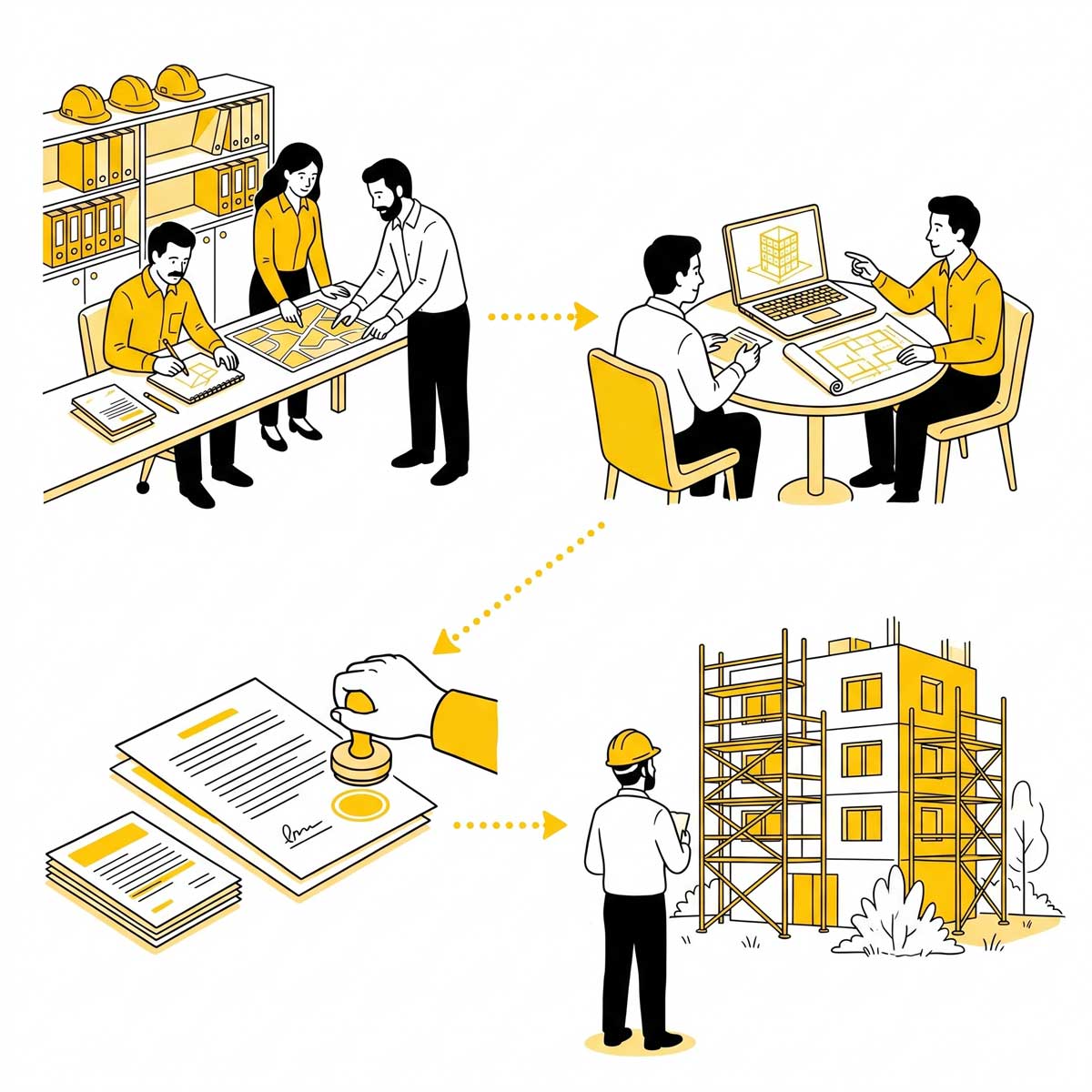
One of the biggest fears when hiring an architect is uncertainty: not knowing how much it will cost, how long it will take, or what happens if something does not go as expected. Our way of working is designed to eliminate that uncertainty from the very beginning. The process has four phases, and we accompany the client in all of them:
Phase 1 — Analysis and Feasibility: Before drawing anything, we study whether the project is viable: urban planning regulations, technical constraints of the land or existing building, and estimation of real costs. This phase avoids subsequent surprises and allows for informed decision-making from the start.
Phase 2 — Project Design and Development: We develop the complete architectural project, from the preliminary design to the execution project with all the necessary technical documents. We work with cutting-edge design and calculation tools and maintain continuous budget control throughout the entire process.
Phase 3 — Licensing and Procedures Management: We handle all administrative procedures: association approval, building permit application, and coordination with the Town Council and competent administrations. The client does not have to manage anything with the administration.
Phase 4 — Site Supervision and Final Control: During construction, we supervise the execution to guarantee that what is built matches the design, on time and within budget. Site supervision is the phase where the client’s investment is protected.
WHY CHOOSE US?
We are not the biggest nor the cheapest studio. We are the studio that will know your project in depth and will be available when you need it. Some specific reasons why our clients choose us:
Knowledge of the territory: We regularly work in A Coruña, Costa da Morte, Carballo, and the metropolitan area of Pamplona. We know the local regulations, municipal technicians, and construction solutions that work in each context.
Commitment to efficiency: We integrate sustainability and low energy consumption criteria into our projects as part of the design process from the beginning.
Recognized track record: Our practice has been awarded in national and international architecture and urban planning contests.
Comprehensive management: We manage the project from start to finish. The client does not have to coordinate between different professionals or chase administrative procedures.
Manageable size: We are a medium-sized studio: enough technical capacity for complex projects, enough proximity so that the client always knows who they are talking to.
FREQUENTLY ASKED QUESTIONS
How much does it cost to hire an architect in Galicia or Navarre?
The fees of an architect in Galicia or Navarre depend on the type of project, its complexity, and the scope of the commission. There is no fixed rate since the liberalization of professional fees, so each studio establishes its own conditions.
Generally speaking, fees are calculated as a percentage of the construction budget or as a flat fee for well-defined commissions. At vi17 arquitectura, we always make a personalized fee proposal after an initial free meeting.
The most important thing: hiring an architect is not an expense, it is an investment. A well-drafted project avoids construction cost overruns, legal problems, and technical solutions that later have to be corrected.
Do I need an architect to renovate my house?
It depends on the type of renovation. In Spain, minor works —painting, flooring, small interior modifications without affecting the structure— generally do not require an architect’s project, although they may need a prior communication to the Town Council.
However, any intervention that affects the structure of the building, changes the use of space, modifies the facade, or requires a major building permit does need a project signed by an architect or technical architect, depending on the type of action.
In case of doubt, it is highly recommended to consult: administrative errors in works can lead to penalties and problems in future property transfers.
How long does an architectural project take?
Deadlines vary depending on the scale and complexity of the project. As a guideline:
Preliminary design (first design proposals): 3 to 6 weeks.
Basic project (necessary to apply for a permit): 6 to 10 weeks.
Execution project (complete technical documentation): an additional 8 to 12 weeks.
Building permit (processing before the Town Council): variable depending on the municipality, between 2 and 6 months.
These deadlines are guidelines and depend on the complexity of the project, the workload of the studio, and the response times of the administration. In the initial meeting, we always provide a realistic estimate for each specific case.
Can you design a house with timber structure in Galicia?
Yes. Timber construction in Galicia is technically viable and has clear advantages in terms of energy efficiency and reducing the carbon footprint. Like any construction system, it requires careful execution and a correct resolution of details to perform well in the Atlantic climate. It is an option that we assess and consider when it fits the goals of the project. If you are interested in exploring it, we can guide you on whether it is the most suitable solution for your specific case.
Do you work outside Carballo and Galicia?
Yes. In addition to our office in Carballo (A Coruña), we have a presence in Pamplona (Navarra), which allows us to work with agility both on the Galician Atlantic axis and in the north of the peninsula.
For projects in other geographical areas, we assess each commission individually. Distance is not necessarily an impediment, especially in projects where most of the work is developed in the studio.
What is the difference between an architect and a technical architect?
The architect is responsible for the complete architectural project: design, structure, installations, technical documentation, and project management (dirección facultativa). They are the one who signs the project submitted to obtain the building permit.
The technical architect (or surveyor) is responsible for the construction site management (dirección de ejecución de obra): they check that the construction is carried out according to the project, verify materials and measurements, and issue the final certificate of work.
In many projects, both figures work together. At vi17 arquitectura, we coordinate with trusted technical architects to offer the client comprehensive management of the construction process.
Do you do rehabilitation projects for buildings with heritage protection?
Yes. Intervening in listed buildings or buildings with heritage protection is one of our fields of work. These projects require a specific methodology: a prior analysis of the building’s condition, coordination with the relevant heritage authorities, and a proposal that balances the preservation of original architectural values with contemporary habitability requirements.
Can I request an initial meeting without commitment?
Yes, and we highly recommend it. A first conversation, either in person or via video call, allows us to understand your project and give you a real orientation regarding feasibility, deadlines, and fees before you make any decision.

Galicia
Rúa Valle Inclán 17, Entreplanta D
15100, Carballo, A Coruña
Navarra
Calle Fuente de la Teja, 12, local 3
31006, Pamplona, Navarra
Contacto
Email: info@vi17.gal
Teléfono: +34 881 309 548